Public documentation edition. Account, subscription, and environment names are replaced with examples. Raw execution evidence, configuration files, and PDFs are not published here.
Microsoft Discovery — Azure Architecture and Version Dependencies
English · Technical sources checked 2026-09-25 · Documentation revised 2026-10-02 · Cloud service
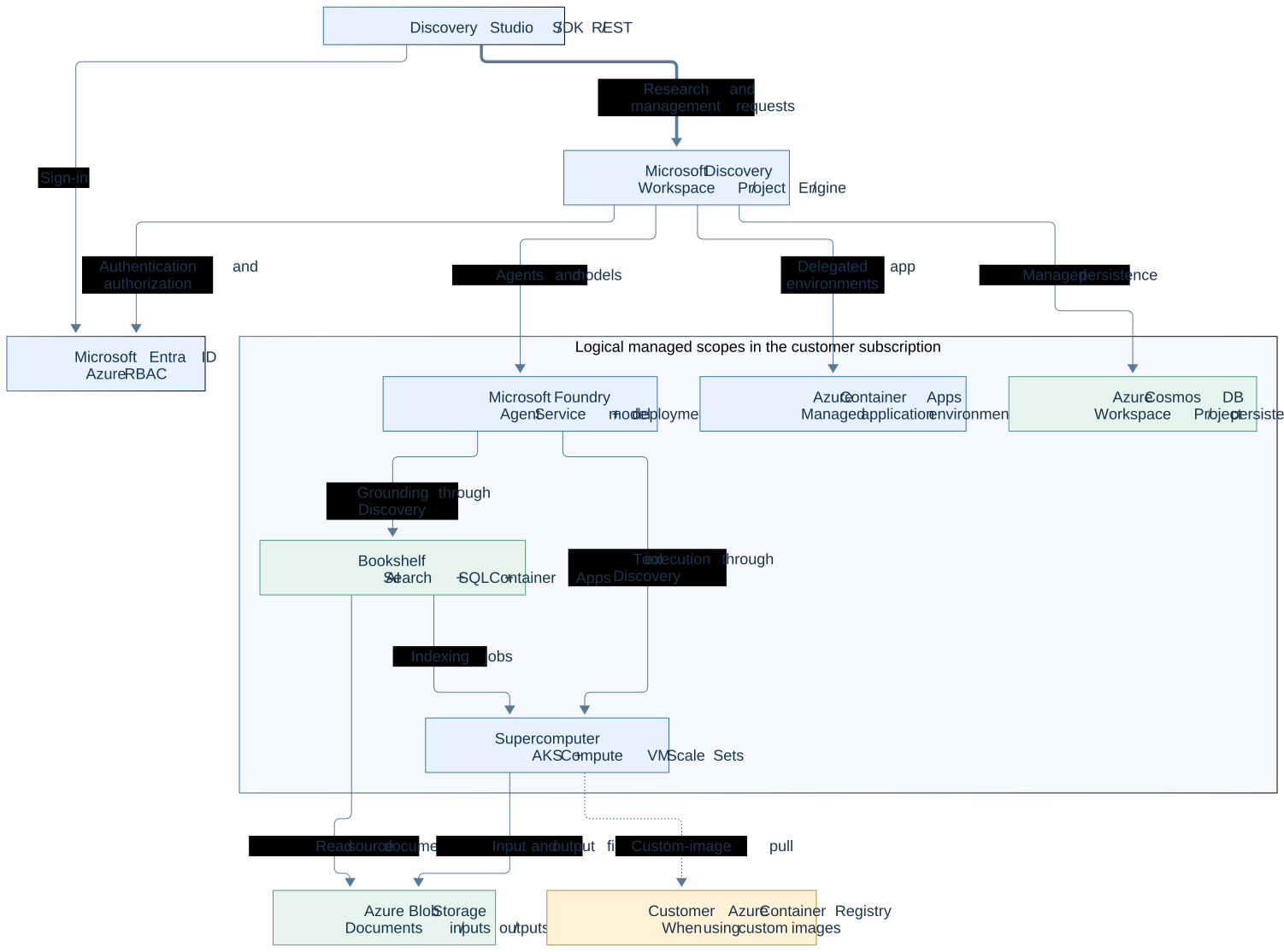
Bottom line: Discovery connects Foundry agents/models, the AKS-based Supercomputer, and Bookshelf's knowledge stack. Within Bookshelf, Azure AI Search handles document enrichment, Azure SQL Database stores the knowledge graph/vectors, and Azure Container Apps serves search. Workspaces/Projects use Cosmos DB; file inputs/outputs use linked storage such as Blob Storage.R01 R02 R04 R05 R06
This is a documentation-based reference architecture, not an inventory of an inspected Azure subscription or a fixed internal software BOM. Where public documentation does not specify an exact Kubernetes, database-engine, or service-build dependency, this document does not invent one.
First reading: Overall architecture → Bookshelf indexing/search → Networking and identity. For version reviews, use the distinctions below and change impacts. Shared customer procedures are in guide S00; environment-specific attempts and observations belong to the separate deployment reference, Korean. A component appearing in a diagram does not mean it has been deployed or verified.
1. Separate the meanings of “version”
| Category | Example | Meaning |
|---|---|---|
| Management API contract | 2026-06-01 |
ARM request/response schema, not an internal service build |
| Model name | gpt-5.4 |
Selected model; the provider revision is separate |
| Deployment name | gpt-5-4 |
Logical name referenced by Discovery, not a model version |
| Model revision | modelVersion, model.version |
Provider-published version to inspect and record on the deployment |
| SKU/hardware generation | S1, E4, Gen5, Standard_D4s_v6 |
Billing/performance/hardware configuration, not a service or Kubernetes version |
| Runtime/artifact version | Kubernetes, node image, container digest | Directly affects execution compatibility; inspect the deployment/image |
| Encryption-key version | keyVersion |
A particular Key Vault key version, not the Key Vault service version |
Tables use D = documented contract/relationship, E = example/configuration, and O = deployment observation required. “Unconfirmed” does not mean “latest” or “unrestricted.”
2. Overall architecture
Mermaid source
graph TB
  CLIENT["Discovery Studio / SDK / REST"]
  ENTRA["Microsoft Entra ID<br/>Azure RBAC"]
  DISC["Microsoft Discovery<br/>Workspace / Project / Engine"]
  subgraph MANAGED["Logical managed scopes in the customer subscription"]
    FOUNDRY["Microsoft Foundry<br/>Agent Service + model deployments"]
    APPS["Azure Container Apps<br/>Managed application environments"]
    COSMOS["Azure Cosmos DB<br/>Workspace / Project persistence"]
    BOOK["Bookshelf<br/>AI Search + SQL + Container Apps"]
    HPC["Supercomputer<br/>AKS + Compute VM Scale Sets"]
  end
  BLOB["Azure Blob Storage<br/>Documents / inputs / outputs"]
  ACR["Customer Azure Container Registry<br/>When using custom images"]
  CLIENT -->|"Sign-in"| ENTRA
  CLIENT ==>|"Research and management requests"| DISC
  DISC -->|"Authentication and authorization"| ENTRA
  DISC -->|"Agents and models"| FOUNDRY
  DISC -->|"Delegated app environments"| APPS
  DISC -->|"Managed persistence"| COSMOS
  FOUNDRY -->|"Grounding through Discovery"| BOOK
  FOUNDRY -->|"Tool execution through Discovery"| HPC
  BOOK -->|"Indexing jobs"| HPC
  BOOK -->|"Read source documents"| BLOB
  HPC -->|"Input and output files"| BLOB
  HPC -.->|"Custom-image pull"| ACR
  classDef core fill:#e8f1ff,stroke:#3974a6,color:#18344e
  classDef data fill:#e6f4ed,stroke:#57957c,color:#18344e
  classDef optional fill:#fff2d7,stroke:#ba8b31,color:#18344e
  class DISC,FOUNDRY,APPS,HPC core
  class COSMOS,BOOK,BLOB data
  class ACR optional
Arrows express logical usage/dependency, not exact packet routes, process-call order, or resource counts. Dashed edges are conditional. A conditional customer-owned ACR does not mean a container image is unnecessary. Foundry represents logical service/model deployments, not a claim that inference GPUs reside inside the customer's VNet.
Discovery documentation describes managed resource groups (MRGs) for Workspace, Bookshelf, and Supercomputer. Actual deployments can have additional groups such as an AKS node resource group. Do not infer exact group names, counts, or resource counts from this diagram.R02 R07
3. Bookshelf indexing and querying have different dependencies
Mermaid source
graph LR
  subgraph BUILD["Index preparation and execution"]
    INDEX["Bookshelf indexing coordination"]
    ENRICH["Azure AI Search<br/>Text extraction and enrichment"]
    COMPUTE["Supercomputer<br/>Knowledge-graph construction job"]
    EMBED["Foundry / Azure OpenAI<br/>text-embedding-3-small"]
  end
  SOURCE["Azure Blob Storage<br/>Source documents"]
  SQL["Azure SQL Database<br/>Knowledge graph + vector KB"]
  subgraph QUERY["Search and grounded responses"]
    AGENT["Discovery agent"]
    SEARCH["Azure Container Apps<br/>Bookshelf query runtime"]
    LLM["Foundry / Azure OpenAI<br/>gpt-5.2 + gpt-5-mini"]
  end
  INDEX -->|"Use enrichment"| ENRICH
  ENRICH -->|"Read sources"| SOURCE
  INDEX -->|"Compute job"| COMPUTE
  INDEX -->|"Generate embeddings"| EMBED
  INDEX -->|"Store index results"| SQL
  AGENT ==>|"Grounding query"| SEARCH
  SEARCH -->|"Read graph and vectors"| SQL
  SEARCH -->|"Query decomposition and answers"| LLM
  classDef compute fill:#e8f1ff,stroke:#3974a6,color:#18344e
  classDef data fill:#e6f4ed,stroke:#57957c,color:#18344e
  class INDEX,COMPUTE,SEARCH compute
  class SOURCE,SQL data
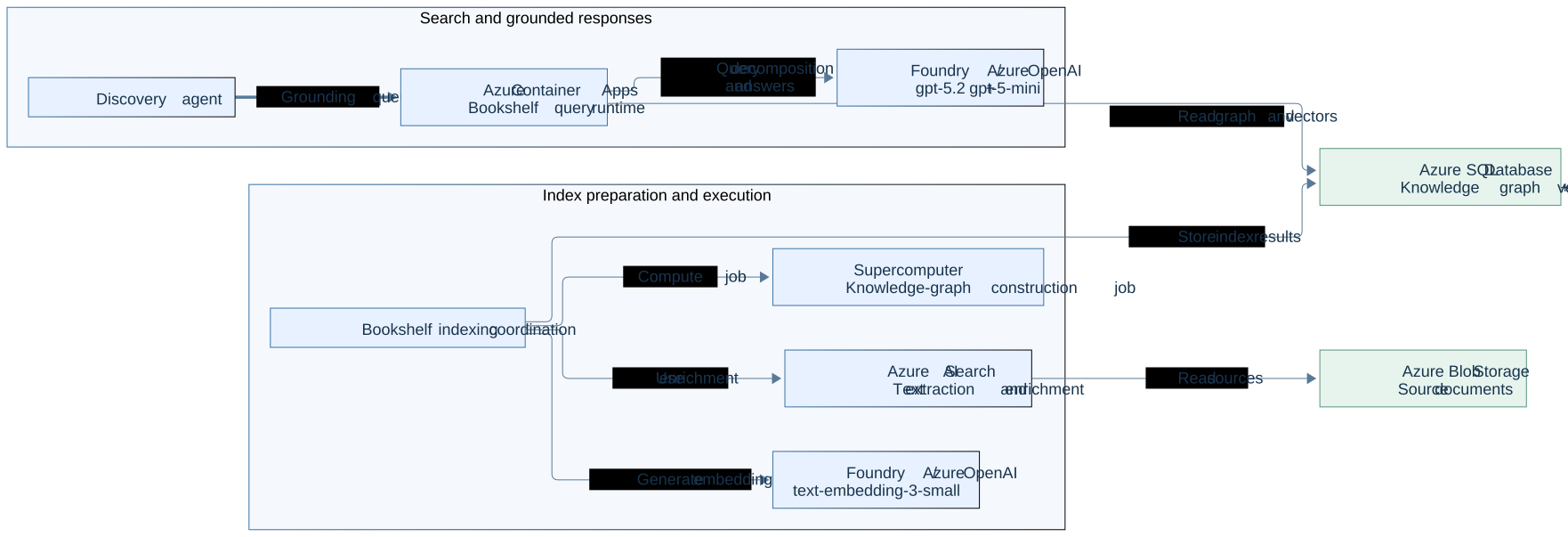
This is also a logical dependency view. It does not claim that a particular indexing process writes directly to SQL rather than through an intermediate service.R04 R05 R06
- Indexing: Blob sources, extraction/enrichment, embeddings/high-memory computation, and SQL graph/vector storage are linked.
- Querying: Search runtime and models use an existing KB. Check an indexing-pool failure and an existing-KB query failure separately.
- Opening citations: Obtaining a search response and a user opening the source Blob have different access/network paths.
- Do not confuse graph stores: A “knowledge graph” does not imply a mandatory Cosmos DB Gremlin or Neo4j deployment. The cited Bookshelf documentation explicitly places its KB in Azure SQL DB.
4. Azure components, roles and version evidence
“Required” means required within the selected capability, not that every Workspace always creates all these resources in the same counts/SKUs.
| ID | Azure component | Role and applicability | Published version/SKU evidence and remaining checks |
|---|---|---|---|
| D01 | Microsoft Foundry Agent Service / Azure OpenAI | Agents, cognition/validation, Bookshelf model calls | D: Default model/deployment names in section 5. O: Provider revision/upgrade policy. The cited material does not pin Foundry's internal service build.R04 R17 |
| D02 | Azure Container Apps (Microsoft.App) |
Delegated Workspace/agent environments and Bookshelf search | E: Bookshelf Small/Medium/Large profiles E4/E8/E16. O: Actual profiles, replicas, images. These are not internal ACA/Kubernetes version pins.R02 R04 R14 |
| D03 | Azure Cosmos DB (Microsoft.DocumentDB) |
Managed persistence associated with Workspaces/Projects | E: Quota guidance lists minimum 2,400 RU/s per Workspace and 400 per Project. O: Actual account/API type/throughput. RU/s is not a version; collections/internal schemas are not established here.R02 R04 |
| D04 | Azure Kubernetes Service | Supercomputer's Kubernetes execution/orchestration foundation | D: AKS-based. The cited Discovery contracts do not mandate a specific Kubernetes semver. O: Actual control-plane/pool versions and node images. Do not substitute generic AKS “latest” for a Discovery requirement.R01 R07 R12 |
| D05 | Azure Compute / Virtual Machine Scale Sets | System, tool, and indexing CPU/GPU nodes | D: Supercomputer systemSku schema allows D4s_v4/v5/v6. E: Sample tool pool Standard_D4s_v6. O: VM/OS/image/driver compatibility. v6 is not a Kubernetes version.R07 R12 R14 |
| D06 | Azure AI Search (Microsoft.Search) |
Bookshelf document enrichment | E: The how-to specifies Standard S1, 2 replicas. O: Actual configuration and API usage. No Discovery-specific internal Search data-plane API pin is established by the cited material.R04 R05 R06 |
| D07 | Azure SQL Database (Microsoft.Sql) |
Bookshelf knowledge-graph and vector KB storage | E: The how-to specifies Hyperscale Standard-series (Gen5), 20 vCores, zone redundancy. Gen5 is not an engine version. O: Actual DB SKU/compatibility settings; no fixed SQL engine-build requirement is established here.R05 R06 |
| D08 | Azure Blob Storage | Source documents, tool inputs/outputs, physical Asset files | E: Public sample uses StorageV2, Standard_GRS, TLS1_2. The lab's Standard_LRS is a separate choice; the hardened example also uses LRS. O: Redundancy, firewall, key-auth policy. Kind/SKU/TLS are not Storage's internal version.R09 R14 R16 |
| D09 | Azure Container Registry | Custom container-image path | Customer ACR is conditional on image strategy. O: Digest, CPU architecture and package versions—not just image tag. ACR's service version does not pin the tool version.R07 R25 R26 |
| D10 | Microsoft Entra ID, Managed Identities, Azure RBAC | User authentication, platform operations and tool data access | D: UAMIs, roles and scopes; distinguish the three identity layers in section 6. O: Actual bindings/permissions. Identity IDs and role names are not software versions.R02 |
| D11 | VNet, NSP, Private Link, Private DNS, network egress | Managed-resource protection and API/storage connectivity | D: Workspace/Bookshelf hardening is documented as default from 2026-02-01-preview; customer API PEs are separate. O: Actual publicNetworkAccess/DNS/egress. An API date is not a network-engine version.R08 R09 R12 |
| D12 | Azure Key Vault | Service-managed resources and customer CMK storage | Key Vault can be among documented MRG resources; a customer CMK vault is optional. D: Explicit CMK keyVersion; RSA 2048/3072/4096 support. These are key settings, not service versions.R02 R10 |
| D13 | Azure Monitor / Log Analytics | Diagnostics and CMK-protected logs | D: CMK-enabled Workspace/Bookshelf/Supercomputer requires a Log Analytics dedicated cluster. O: Actual cluster/workspace/capacity/retention. A regular workspace is not a dedicated cluster.R10 R11 R12 |
| D14 | Azure NetApp Files | Conditional high-performance HPC file storage | D: AzureNetAppFiles storage kind is supported. O: Actual volume/protocol/tier. The cited material does not establish a universal Discovery ANF/NFS version pin.R07 R16 |
| D15 | Disk Encryption Set (Azure Compute resource) | Supercomputer CMK disk-key binding | D: Supercomputer CMK requires diskEncryptionSetId. This is a resource/key binding, not a separate product version; coordinate its lifecycle with Key Vault.R10 R12 |
Provider registration is not a deployment BOM. Prerequisites include providers such as Microsoft.Web, Microsoft.ContainerInstance, Microsoft.MachineLearningServices, Microsoft.Bing, Microsoft.ResourceGraph, and Microsoft.Insights. Registration alone does not establish that every deployment contains an instance of each service or depends on a particular runtime version. Inspect the actual inventory.R03 R24
5. Which versions are actually specified?
Models and APIs
| ID | Item | Documented value | Interpretation |
|---|---|---|---|
| V01 | Discovery management API | 2026-06-01 — checked Workspace, Supercomputer, ChatModelDeployment schemas |
Management contracts for those resource types; not a universal data-plane API version.R11 R12 R13 |
| V02 | Tool-job data-plane example | 2026-02-01-preview |
The cited how-to's example contract. Cloud GA does not remove its Preview designation.R15 |
| V03 | Default cognition/agent/validation path | gpt-5.4; validation deployment name gpt-5-4 |
Distinguish automatic cognition and validation deployments. Adding another agent model does not justify arbitrarily replacing validation.R04 |
| V04 | Bookshelf models | gpt-5.2, gpt-5-mini, text-embedding-3-small |
Documented defaults for decomposition/answers, search, and embeddings. Inspect actual provider revisions.R04 R05 |
| V05 | ChatModelDeployment configuration | modelFormat, modelName, optional modelVersion, skuName, capacity |
GA schema supports revision selection, but the public quickstart does not set modelVersion. Do not convert capacity units to TPM identically for every model.R13 R14 |
| V06 | Model upgrade policy | versionUpgradeOption |
Varies by model/provider/deployment type. Do not apply documented Standard policies indiscriminately to Provisioned or partner deployments.R19 R20 |
| V07 | Actual AKS runtime | currentKubernetesVersion, pool currentOrchestratorVersion, nodeImageVersion |
O: This reference does not include a deployed BOM. Inspect and record each deployment; distinguish requested, latest-supported and currently running versions.R21 R22 |
| V08 | Internal Bookshelf GraphRAG implementation | GraphRAG/LazyGraphRAG is described | Do not equate it to a particular open-source graphrag package version. An internal build/schema pin is not established by these public sources.R05 R06 |
| V09 | Tool version | Definition content version + container digest | Customer-controlled contract/artifact. An immutable agent version does not automatically freeze referenced model revisions, tools, or mutable image tags.R17 R25 R26 |
For example, creating gpt-5.4 under deployment name gpt-5-4 using API 2026-06-01 combines a model name, a deployment name, and an API contract. The effective model revision and upgrade policy still require separate inspection.
Public Bicep example API versions—not product-wide minimum requirements
| Example resource | Example API version |
|---|---|
Microsoft.Discovery/workspaces, supercomputers, supercomputers/nodePools, workspaces/projects, workspaces/chatModelDeployments, storageContainers |
2026-06-01 |
Microsoft.Network/virtualNetworks |
2024-05-01 |
Microsoft.ManagedIdentity/userAssignedIdentities |
2024-11-30 |
Microsoft.Storage/storageAccounts and Blob child resources |
2023-05-01 |
Microsoft.Authorization/roleAssignments |
2022-04-01 |
These are E values read from the public example, not evidence that Discovery internally calls all managed services using the same API versions. The observed file's SHA-256 is 7092563897d47b4870797236d90d84dc65635f2bb87c398591f16174e48b29aa. master is mutable; this is an observed-file checksum, not a commit pin.
6. Conditional security and CMK dependencies
Mermaid source
graph TB
  RES["Discovery resources"]
  NET["Azure VNet / delegated subnets<br/>NSP / managed-resource private endpoints"]
  UAMI["Customer UAMI + Azure RBAC"]
  ENTRY["Workspace / Bookshelf<br/>Customer API access"]
  PE["Private Link + Private DNS<br/>Customer private endpoints"]
  CMK["Customer-managed key mode<br/>Selected at creation"]
  KV["Azure Key Vault<br/>Explicit keyVersion"]
  LOG["Log Analytics dedicated cluster<br/>CMK-protected logs"]
  DES["Disk Encryption Set<br/>Supercomputer CMK"]
  ANF["Azure NetApp Files<br/>Selected HPC storage path"]
  RES -->|"Protect managed resources"| NET
  RES -->|"Customer data and tool access"| UAMI
  ENTRY -.->|"Select private API path"| PE
  RES -.->|"When CMK is enabled"| CMK
  CMK -->|"Key dependency"| KV
  CMK -->|"CMK logging dependency"| LOG
  CMK -.->|"For Supercomputer"| DES
  DES -->|"Disk key"| KV
  LOG -->|"Log key"| KV
  RES -.->|"When selecting this storage kind"| ANF
  classDef managed fill:#e8f1ff,stroke:#3974a6,color:#18344e
  classDef conditional fill:#fff2d7,stroke:#ba8b31,color:#18344e
  class RES,NET,UAMI managed
  class PE,CMK,KV,LOG,DES,ANF conditional
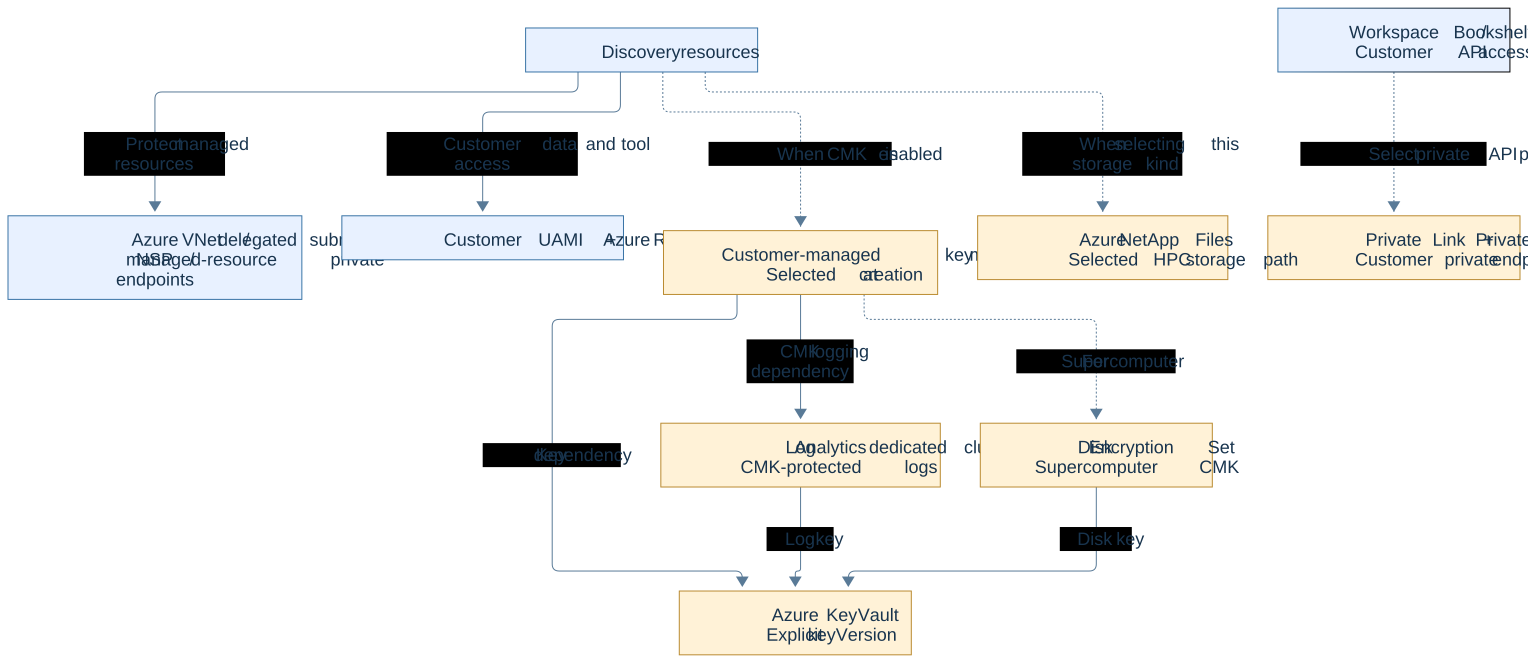
There are three identity layers: user Entra ID/RBAC, customer UAMIs for data/image access, and Discovery service principals/internal managed identities for MRG operations. Do not say every Azure call uses one UAMI. Workspace and Supercomputer cluster-identity bindings are documented as immutable after creation; kubelet/workload identities have separate update paths.R02
CMK means more than adding a Key Vault. Workspace/Bookshelf needs key references and a Log Analytics dedicated cluster; Supercomputer additionally needs a Disk Encryption Set. MMK↔CMK switching after creation is documented as unsupported. During rotation, update Workspace/Bookshelf references and the Supercomputer DES through their respective paths, and do not disable an old key until its dependents have been checked.R10
Separate these network controls:
| Control | What it does—and does not—establish |
|---|---|
| Default network hardening | Protects MRG backends; it is not the same switch as disabling public customer API access |
Workspace/Bookshelf publicNetworkAccess |
Documented default Enabled allows public and PE paths; Disabled rejects the public path |
| Supercomputer API-server VNet Integration | Configures node→API-server connectivity; do not equate it to a fully private cluster or removal of a public FQDN |
Supercomputer outboundType |
The public schema defaults to LoadBalancer. With None, the customer must provide required outbound connectivity; inspect image, storage, and external-tool paths separately |
Blob allowBlobPublicAccess=false |
Disables anonymous access, not every public-network path used by an authorized identity |
Model GlobalStandard / DataZoneStandard |
Affects processing location, quota and billing. Private Link or the Workspace region alone does not pin inference geography |
The hardening articles include “zero public exposure” summaries alongside separate public-access/API-server conditions. Therefore inspect actual DNS, publicNetworkAccess, AKS API access profile, outboundType, Blob firewall, and model deployment type independently. The sample Bicep also combines NetworkIsolation=true with customer Storage networkAcls.defaultAction='Allow' and Preview Workbench defaults. Do not treat the sample as a completed security-hardening assessment.R08 R09 R12 R14 R18
7. Cross-service change and failure impacts
These are operational implications derived from documented dependencies, not failure-test results or SLA guarantees. Verify scope and probe each actual path.
| ID | Change/problem | Potential impact | Important distinction |
|---|---|---|---|
| I01 | Model revision or upgrade-policy change | Planning, tool selection, answers, and Task validation can change | API and model-weight changes are separate. Standard NoAutoUpgrade does not guarantee continued use after retirement |
| I02 | Missing/misconfigured gpt-5-4, insufficient model quota |
Engine startup/validation or agent calls can fail | Do not conclude every already-running pure-compute job immediately terminates |
| I03 | AKS/node image/CPU-GPU architecture change | Image/library/driver compatibility and new-job startup can change | Do not independently apply a generic AKS upgrade to a Discovery-managed cluster |
| I04 | Insufficient indexing memory/vCPU | New KB indexing/updates can fail | Test existing KB queries separately through SQL/ACA/models |
| I05 | AI Search enrichment failure | Document extraction and new indexing-input preparation can fail | This does not mean an existing SQL KB was immediately lost |
| I06 | SQL/ACA search-layer problem | Bookshelf queries/grounding can slow or fail | Separate from retention of original Blob files |
| I07 | Blob RBAC/CORS/firewall change | Inputs, outputs, or opening citations can fail | Managed-identity file creation and user file access are separate probes |
| I08 | ACR access or image-tag change | New containers can fail to start or behave differently | Distinguish running jobs, cached images, and the effective digest |
| I09 | Old CMK disabled or key permission revoked | Dependent data, disk, or logging paths can fail | Check Workspace/Bookshelf keyVersion, DES, and Log Analytics together |
| I10 | Identity/network/CMK creation-time binding change | Some changes require recreation and relinking | A property existing in an ARM schema does not make it freely mutable after creation |
| I11 | Management API or SDK change | Request schema, defaults, and supported properties can change | GET with a newer API does not migrate an existing deployment to a new security/runtime configuration |
| I12 | Engine Stop or node scale-to-zero | Reduces new cognition work or compute-node consumption | Existing work and always-on SQL/Search/ACA costs remain separate; runtime User Messages and infrastructure billing are also separate |
Minimum post-change probes: basic agent call → KB search with actual citations → small tool run and readable output → Engine validation → stop/remaining-work/cost checks. Change managed resources only through supported Discovery procedures; do not independently delete, upgrade, or downsize MRG components.R04 R07 R10 R17 R19 R27
8. Inspect an actual deployment's versions/BOM
These are post-deployment examples for authorized read access. This section does not contain actual lookup results. Use actual IDs/MRG names; do not replace null or an access denial with “latest/absent.” Inspect the Workspace/Bookshelf/Supercomputer MRGs and any discovered node resource group separately.
Run the blocks in the same Bash session after setting the first block's variables. Replace every <...> placeholder; the examples do not use az account set to change the default subscription.
Inventory
SUBSCRIPTION_ID='<subscription-id>'
MRG='<actual-managed-resource-group>'
az resource list --subscription "$SUBSCRIPTION_ID" --resource-group "$MRG" \
  --query "[].{id:id,type:type,region:location,sku:sku.name,kind:kind}" \
  --output json
Follow up with the individual resource GET if the list omits SKU/details. Do not dump secrets, keys, or full connection strings.
Discovery model contract and effective Foundry deployments
CHAT_MODEL_ID='<actual-discovery-chatModelDeployment-resource-id>'
az resource show --subscription "$SUBSCRIPTION_ID" --ids "$CHAT_MODEL_ID" \
  --api-version 2026-06-01 \
  --query "{name:name,model:properties.modelName,revision:properties.modelVersion,sku:properties.skuName,capacity:properties.capacity}" \
  --output json

FOUNDRY_NAME='<actual-managed-foundry-account-name>'
az cognitiveservices account deployment list \
  --subscription "$SUBSCRIPTION_ID" --resource-group "$MRG" --name "$FOUNDRY_NAME" \
  --query "[].{name:name,model:properties.model.name,revision:properties.model.version,sku:sku.name,capacity:sku.capacity,upgradePolicy:properties.versionUpgradeOption}" \
  --output json
These inspect different resource representations. Include the automatically provisioned cognition deployment in the actual inventory. An exposed modelVersion property does not authorize arbitrary customer changes to every service-managed model revision.R13 R19 R20 R23
AKS and node pools
AKS_RG='<actual-aks-resource-group>'
AKS_NAME='<actual-aks-cluster-name>'
az aks show --subscription "$SUBSCRIPTION_ID" --resource-group "$AKS_RG" --name "$AKS_NAME" \
  --query "{requestedVersion:kubernetesVersion,runningVersion:currentKubernetesVersion,nodeResourceGroup:nodeResourceGroup}" \
  --output json

az aks nodepool list --subscription "$SUBSCRIPTION_ID" \
  --resource-group "$AKS_RG" --cluster-name "$AKS_NAME" \
  --query "[].{name:name,requestedVersion:orchestratorVersion,runningVersion:currentOrchestratorVersion,nodeImage:nodeImageVersion,vmSize:vmSize}" \
  --output json
Pool metadata alone does not prove every node is identical during a rolling upgrade. Where necessary, an authorized operator verifies per-node runtime/image/driver state. No cluster-admin credential retrieval or upgrade command is included here.R21 R22
Record in the final BOM: Observation time/resource IDs; effective model revisions and policies; Kubernetes/node images; SKUs/capacity; image digests/tool libraries; CMK keyVersion/DES/log bindings; network/identity bindings. Internal service versions not exposed through authorized reads remain questions for Microsoft support/service owners.
9. Sources and evidence boundary
API/model/SKU values were checked against these sources. Examples/recommendations, supported contracts, and actual deployment observations are distinguished. Structure, diagram topology, and row IDs match the Korean edition.